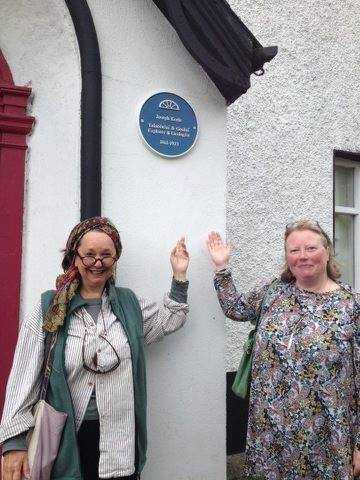
If you would care to travel back in time and imagine stepping into a horse drawn carriage for your tour of the town, not only would you find you were in a place that had been renamed Parsonstown, you’d notice other differences. Here are a few of them:
- Emmet Square was named Duke Square or Cumberland Square. It was renamed in 1922, in honour of Robert Emmet (nationalist, orator and rebel leader of 1803.) On the original design drawings by young Samuel Chearnley, the column was moated. The local sandstone ‘pillar of victory’ supported a life sized statue of the Duke of Cumberland in the costume of a Roman Emperor. It was removed by the council in 1915 for safety reasons (and not, as one tale goes, by disgusted Scottish soldiers.) The arm is on display in Birr Library.
- There were once numerous hotels and guesthouses in Birr. For the castle’s fireworks display in the 19th century, they were full to brimming with thousands of visitors.
- Wesley preached in Market Square. This area and The Green, had vibrant markets on Fridays and Saturdays.
- Wilmer Road was previously known as Oxmantown Mall.
- Rosse Row was known previously as White’s Row.
- Oxmantown Mall, originally known as Oxmantown Place. The house numbers were previously reversed, which required careful research before placing the plaques!
- On Bridge Street, homes and shops spanned both sides of the mediaeval bridge, until the 1970s, when they were unnecessarily demolished.
- John’s Hall was built by the 2nd Earl of Rosse in honour of his son who had died of Scarlet Fever aged 26. Built in 1833 at a cost of £1,100, it has served as a Mechanics Institute, Town Hall and exhibition space. This trail was launched here.
- Moorpark Street: near the pub, is one of the oldest existing parts of the town. Very little except part of a wall is left of the Bridewell/old gaol. Further along this street you can see what remains of the old gasworks – a tall chimney within a private garden, on the left – which lit the streets and homes. Old gas pipes were found deep under some streets during the digging to put in new water pipes and meters.
- The bronze statue of the Third Earl of Rosse is by John Henry Foley – Ireland’s first major figure in Irish sculpture. The statue was unveiled on March 20th 1876. Two of Foley’s other works are The Albert Memorial, London and Daniel O’Connell statue in Dublin.
- Before the mid-19th century, front doors had no letterboxes. There were no pillar boxes (for posting letters) until the renowned English novelist and keen huntsman, Anthony Trollope thought of the idea. (He served as Post Office Surveyor, in Banagher, a few miles from Birr).
- Up until the late 19th century, before the new graveyard was consecrated outside the town, you’d be likely to smell the old one on warm days.
- Seffin, Suigh Finn, Seat of Finn – was the original location of the Seffin Stone: This stone was dramatically removed from Birr by the eccentric Protestant gentleman Honest Tom Steele in December 1833 to his residence at Cullane House, Co. Clare. Steele was a passionate admirer and supporter of Daniel O Connell, being his right hand man for 24 years. He erected a chapel for him at his house with the stone as an altar. It was recovered in the 1970s by the town council and placed in its honoured position beside John’s Hall, once again making its claim as symbolic of the ‘Navel of Ireland” (Umbilicus Hiberniae).
- Oxmantown Bridge was built in 1817 with the parapet lowered in 1855.
- John’s Place, is now known locally by the grander name, ‘John’s Mall’.
- How things have changed! Short Connaught Street alone, was self sufficient: from birth to death all could be supplied to clothe, feed and bury you. Imagine – above most of the shops, the proprietors’ families lived; the sounds of children playing in the street, craftsmen’s hammering, the aroma of fresh baking, the clip and clop of carts and the calls of tradesmen bidding customers a welcome in.
- The cannon in front of John’s Hall was presented to the people of Birr in 1858 having been captured in the Battle of Sevastopol in 1855.